
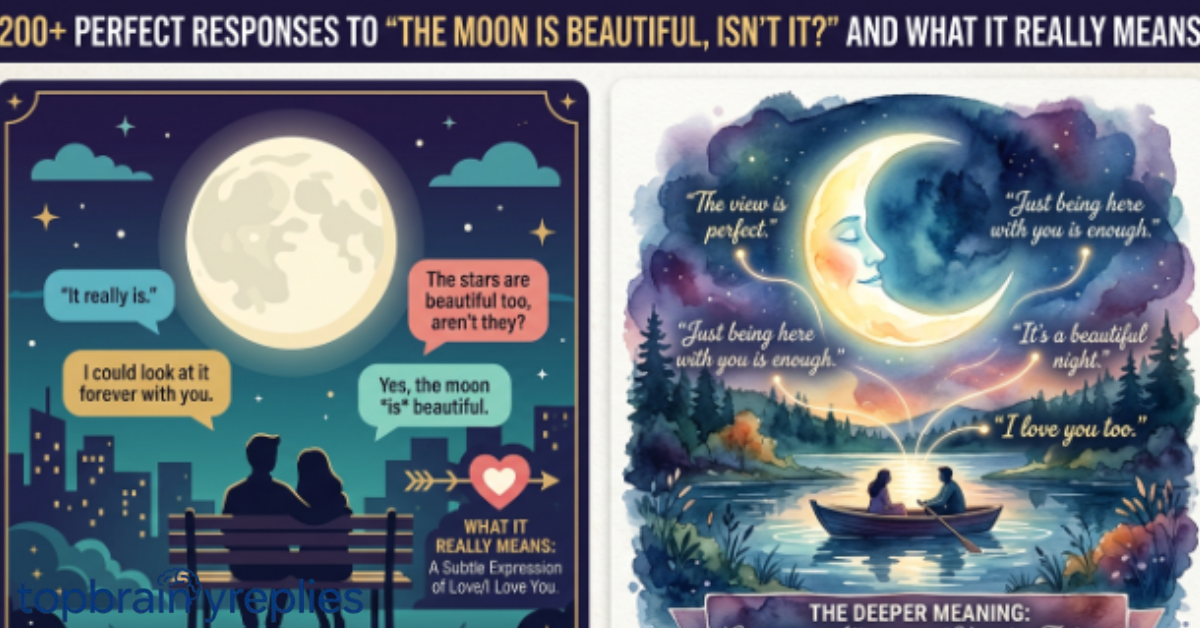
When someone quietly turns to you and says the moon is beautiful, isn’t it, the moment rarely feels like small talk. There is a softness to the question that suggests something deeper is being said without actually being said, which is exactly why finding the right reply can feel more important than it should for a sentence about the night sky. This phrase carries a long history tied to Natsume Sōseki, the celebrated Japanese author often credited with framing it as a gentle, indirect way of expressing love without saying the words outright.
This guide walks through more than two hundred ways to respond, organized by tone and emotional intent, so you can match the mood of the moment whether it feels romantic, playful, wistful, or simply observational. You will also find the deeper meaning behind the phrase itself, how different cultures express the same sentiment, and practical guidance on timing and delivery that matters just as much as the words you choose.
see also: 230+ Best Replies to “How Was Your Night?” – Funny, Romantic & Witty Comebacks
The Real Meaning Behind This Quietly Romantic Phrase

At its core, this phrase functions as a poetic stand-in for feelings someone may not feel ready to state directly. Rather than confessing affection outright, the speaker invites you to share a quiet, beautiful moment, hoping you will read between the lines and understand what is really being communicated. The vulnerability lives in the ambiguity itself, since the phrase can always be taken at face value if the other person is not ready to acknowledge the deeper meaning, which is part of what makes it feel so gentle and low-risk compared to a direct declaration.
Where the Phrase Originated and Why It Endures

The most widely repeated origin story credits Sōseki with suggesting this phrase as a culturally fitting translation of a direct declaration of love, reflecting a broader value in Japanese communication that favors subtlety over bluntness. Whether or not the anecdote is entirely accurate, it has taken on a life of its own, spreading through literature, anime, and everyday conversation as a shorthand for hidden affection. Its endurance likely comes from how universally relatable the sentiment is, since most people, regardless of culture, have experienced the urge to express something meaningful without risking the vulnerability of saying it directly.
Reading the Moment Before You Choose Your Reply
Before settling on a response, it helps to pause and genuinely read the emotional tone of the moment, since the same phrase can carry completely different intentions depending on context. A quiet, hesitant delivery during a private conversation usually calls for a sincere or reflective reply, while the same words said with a grin during a lighthearted hangout probably invite something playful instead. Paying attention to body language, the relationship you share, and the setting itself will guide you toward a response that feels natural rather than mismatched to the mood being set.
Heartfelt and Romantic Responses for a Genuine Moment
When you sense genuine emotion behind the words and want to respond with equal sincerity, a heartfelt reply can deepen the connection significantly. You might say that you have been hoping someone would notice it with you, or admit that everything feels brighter simply because they are standing beside you.
Telling them that the moon has never looked quite this meaningful before, or that its glow reminds you of the warmth they carry, allows you to mirror their vulnerability without overexplaining. A reply built around admitting that this moment, shared specifically with them, feels more beautiful than the sky itself often communicates exactly what an emotional moment like this calls for.
Flirty and Teasing Responses to Lighten the Mood

If the moment feels playful rather than deeply serious, a flirty reply can keep the energy light while still acknowledging the underlying charm of what was just said. You could tease that you suspect they are trying to win you over with the moon as an excuse, or ask lightheartedly whether pointing out the sky earns them bonus points.
Suggesting that the moon might feel a little jealous of the attention they are getting, or admitting you cannot tell whether it is the moon or their smile stealing the spotlight, keeps things fun without dismissing the sentiment entirely. This tone works particularly well for early-stage flirtation where too much sincerity might feel overwhelming.
Deep and Thoughtful Responses for Reflective Moments
Some moments call for a response that leans introspective rather than purely romantic or playful, especially with someone who appreciates poetic or philosophical conversation. You might reflect that the moon seems to hold a story of longing and quiet connection tonight, or wonder aloud whether the universe arranged for you both to witness this particular sky together.
Mentioning that its steady light feels like a quiet companion to unspoken thoughts, or that its glow seems to carry sentiments neither of you have said aloud yet, adds emotional depth without forcing the moment into an explicit confession. These responses suit people who enjoy conversations that linger in ambiguity rather than resolving too quickly.
Casual Responses When There Is No Romantic Intent
Not every mention of the moon carries hidden meaning, and sometimes a straightforward, friendly reply is exactly what the moment calls for. Simply agreeing that the sky looks unusually clear tonight, or mentioning how peaceful the evening feels, keeps the conversation comfortable without reading into it further.
You might add that the glow reminds you of quiet nights spent unwinding, or that it feels like a good night for a bit of stargazing with friends. These neutral responses work well in group settings, casual friendships, or situations where you genuinely just want to appreciate the sky without additional emotional weight attached.
Bittersweet and Longing Responses for Distance or Nostalgia
For situations involving long-distance relationships, past heartbreak, or quiet loneliness, a more melancholic response can capture the bittersweet nature of noticing something beautiful without the person you wish were beside you. You might admit that the moon’s beauty tonight only highlights the distance between you and someone you miss, or that its glow feels comforting yet somehow lonely at the same time.
Saying that the sight brings back memories of nights once shared with someone no longer present, or that the moon feels like the only constant while everything else has changed, allows genuine emotional honesty without needing to explain further. These responses tend to resonate deeply with anyone processing longing, nostalgia, or unresolved feelings.
Poetic Responses for a Literary or Artistic Touch
If you enjoy language that leans toward the lyrical, a more literary response can turn a simple observation into something memorable. You might describe the moon as a quiet witness to thoughts too delicate to say aloud, or mention that its light seems to write an unfinished letter across the night sky.
Comparing the moment to an unspoken poem shared between two people, or describing the glow as a gentle muse for feelings that words cannot fully capture, suits writers, artists, or anyone who wants their reply to feel intentional and crafted rather than casual.
Anime and Pop Culture Inspired Responses
For younger audiences or casual exchanges rooted in shared fandoms, referencing anime or pop culture can make the moment feel playful and relatable. You might joke that the scene feels like it belongs in a slow-burn romance anime, or mention that even the moon seems to be blushing at the timing of the comment. Comparing the atmosphere to a dramatic soundtrack swelling in the background, or noting that the moment feels like the emotional turning point of a favorite series, adds humor while still acknowledging the romantic undertone that inspired the reference in the first place.
Trendy Responses for Texts and Social Media
When the exchange happens over text, direct messages, or social captions, a more modern and casual tone often fits better than something lengthy or overly poetic. You might reply that the moon looks great tonight but that their presence is the real highlight, or joke that no photo could ever capture the vibe of the actual moment.
Mentioning that the scene feels perfectly aesthetic enough for a social media post, or that even your phone camera cannot do justice to how the night actually feels, keeps the tone light and current while still playing into the romantic undertone of the original phrase.
How Other Languages and Cultures Express the Same Feeling
Variations of this quietly romantic sentiment exist well beyond Japanese culture, even if the specific wording differs from language to language. In French, a similar sentiment might compliment the moon while gently noting that it still cannot compare to the person being addressed.
Italian and Spanish expressions often follow a similar structure, acknowledging the beauty of the sky before redirecting the compliment toward the listener themselves. Recognizing these parallels shows that the impulse to express affection indirectly through shared beauty is a nearly universal human tendency, not something unique to a single culture or language.
Timing and Delivery Matter as Much as the Words
How quickly and how genuinely you respond often communicates more than the specific words you choose. A warm, immediate reply tends to signal enthusiasm and emotional presence, while a long delay followed by a flat or dismissive answer can unintentionally close off the moment entirely. If you need a little time to gather your thoughts, a brief acknowledgment followed by a more thoughtful message shortly after usually reads as sincere rather than distracted, whereas silence alone can easily be misread as disinterest.
Choosing the Right Medium for Your Reply
The way you deliver your response, whether spoken aloud, typed in a text, or recorded as a voice note, changes how the sentiment lands. A response said quietly in person carries an intimacy that text simply cannot replicate, since tone of voice and shared silence add meaning words alone cannot convey. A text message allows more room to craft a polished, thoughtful reply, while a voice note captures warmth and hesitation that typed words often lose. Matching your chosen medium to the emotional weight of the moment helps ensure your response feels intentional rather than mismatched to the setting.
Similar Romantic Phrases and How to Respond to Them
This phrase belongs to a broader family of indirect romantic expressions that rely on shared beauty or subtle compliments rather than direct declarations. When someone says they simply enjoy spending time with you, mirroring that sincerity by admitting the feeling is mutual tends to work better than deflecting with humor if you feel the same way.
If someone compares you to something universally admired, such as sunshine or a favorite song, acknowledging the compliment warmly, rather than brushing it off, keeps the moment from feeling awkward. Recognizing these related phrases helps you respond authentically across a range of similarly indirect romantic gestures, not just this one specific line about the moon.
Responding When You Are Not Sure How You Feel
Not every reply needs to fully commit to romantic or platonic territory, especially if you are still processing your own feelings about the moment or the person. A gentle, honest response acknowledging that the moment does feel special, without explicitly confirming or denying romantic intent, allows you room to explore the connection without pressure. Saying that you appreciate the thought behind the comment, or that you have been enjoying the evening more than usual, keeps the conversation open without forcing clarity you are not ready to provide.
Using This Phrase Yourself to Express Hidden Feelings
If you are the one hoping to convey affection indirectly, saying this phrase yourself works best when your tone, timing, and body language align naturally with the sentiment behind it. Choosing a quiet, unhurried moment rather than a rushed or crowded setting gives the phrase room to land the way it is intended. Pairing the observation with a lingering glance or a softer tone of voice often communicates more than the words themselves, since the entire effectiveness of this phrase relies on subtlety rather than explanation.
Common Mistakes to Avoid When Replying
Avoid responding with a flat, disinterested tone if you genuinely want to acknowledge the emotional weight behind the comment, since a dismissive reply can unintentionally shut down a meaningful moment. Do not overanalyze the phrase to the point of overthinking your response into something stiff or rehearsed, since authenticity almost always lands better than a technically perfect line.
Avoid mismatching tone entirely, such as replying with heavy humor when the moment clearly called for sincerity, since tone mismatches can feel jarring rather than charming. Finally, avoid ignoring the moment altogether by changing the subject abruptly, since doing so often reads as discomfort rather than simple disinterest.
Final Thoughts
Responding to a moment this quietly meaningful is less about finding a perfect scripted line and more about genuinely reading the emotion behind the words and mirroring it thoughtfull. Whether the mood calls for something romantic, playful, reflective, or simply casual, the right response comes from paying attention to context rather than reciting a memorized phrase.
With this wide range of tones and examples to draw from, you now have plenty of ways to respond authentically no matter how the moment unfolds. Choose the reply that feels most true to how you actually feel in that instant, and let the conversation develop naturally from there.
see also: 270+ Long Sweet Texts for Girlfriend Far Away – Deep, Romantic & Heartfelt Messages
FAQs
What does “the moon is beautiful, isn’t it” actually mean?
It is often used as an indirect way of expressing affection, inviting the listener to share a meaningful moment without stating feelings outright.
Is this phrase always romantic?
No, it can also be used casually to simply admire the night sky, so context and tone matter more than the words themselves.
What is the best way to respond if I feel the same way?
A sincere reply that mirrors the emotional tone, such as admitting the moment feels special because of their presence, usually works well.
Can I respond with humor if the moment feels playful?
Yes, a lighthearted or teasing reply fits well when the tone feels flirty rather than deeply sincere.
Where did this phrase originally come from?
It is widely associated with Japanese author Natsume Sōseki, who is said to have framed it as a subtle translation of a direct declaration of love.
What if I am unsure how to respond?
A gentle, honest reply acknowledging that the moment feels meaningful, without fully confirming romantic intent, is a safe and genuine option.

I’m Isabella Davis, a skilled AI content writer with 5 years of experience developing informative and original articles.